 Parkinson Social Network
August Staying Connected

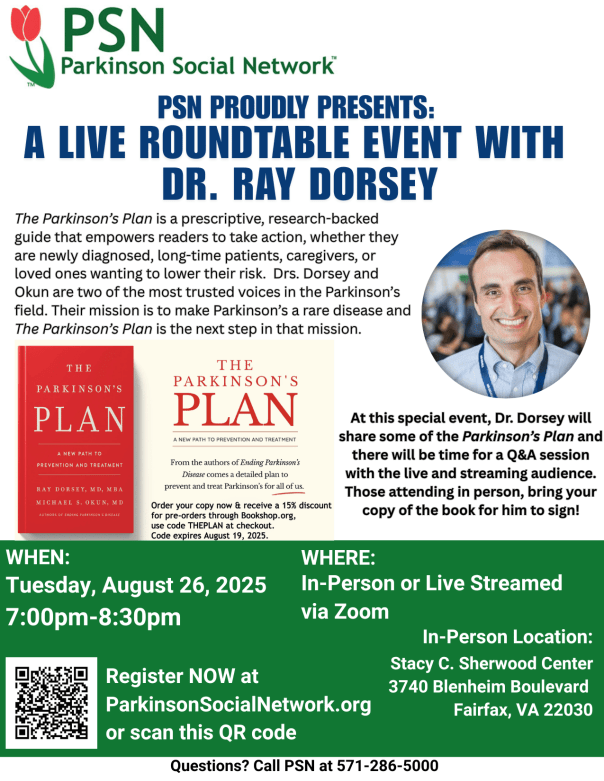
At this special event, Dr. Dorsey will share some of the Parkinson’s Plan and there will be time for a Q&A session with the live and streaming audience. People can join either in-person at the Stacy Sherwood Center in Fairfax, Virginia or via Zoom.
The Parkinson’s Plan is a prescriptive, research-backed guide that empowers readers to take action, whether they are newly diagnosed, long-time patients, caregivers, or loved ones wanting to lower their risk. Drs. Dorsey and Okun are two of the most trusted voices in the Parkinson’s field.
Their mission is to make Parkinson’s a rare disease and The Parkinson’s Plan is the next step in that mission.
· Learn how your food, water, air, and lifestyle choices play a direct role in prevention
· Understand the “Parkinson’s 25”, the most detailed checklist ever created to reduce risk
· Discover the latest scientific breakthroughs and practical treatment options
· Hear from world-renowned experts, doctors, and thought leaders in Parkinson’s research.
I want to register for the In-Person Event
in Fairfax, VA

I want to register for the Streaming/Zoom
Event

Who is Dr Ray Dorsey?
Dr. Dorsey holds a Bachelor of Science in biological sciences from Stanford University, and a joint MD/MBA degree from the University of Pennsylvania Perelman School of Medicine and the Wharton School. From 2010 through 2013, Dr. Dorsey served as Associate Professor of Neurology at Johns Hopkins Medicine. There, he was the Director of the Movement Disorder (Parkinson’s disease) Division and of Neurology Telemedicine, where he created a pioneering virtual care program that reached patients across six continents. In 2014, he returned to Rochester as the David M. Levy Professor of Neurology and Co-Director of the Center for Health and Technology at the University of Rochester Medical Center. He is an author of Ending Parkinson’s Disease (2020) and the forthcoming The Parkinson’s Plan: A New Path to Prevention and Treatment (2025). His deep sense of purpose fuels his passion for research and prevention. “These opportunities don’t come around all the time,” he says. “My impatience is that I know this isn’t the way things have to be. We can do better—and we must.”
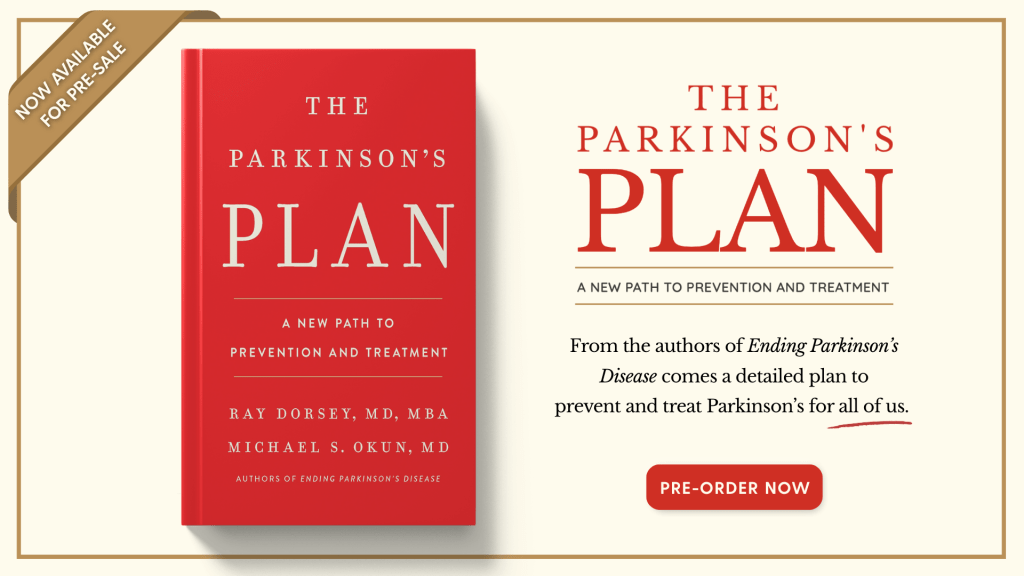
There is a 15% discount code for anyone who preorders the book through Bookshop.org, use code THEPLAN at checkout. This code is valid on print and U.S. orders only. Code expires August 19, 2025!

Happening In Our Community…
- Real Talk: Care Partner Discussion Group 1st and 3rd Thursday of Each Month, hosted by: PMD Alliance. Exclusively for Care Partners supporting someone on their journey with a movement disorder. NO REGISTRATION REQUIRED. Use this link to join.
- PERSEVERE is a fully virtual, national trial for family caregivers of loved ones with Parkinson’s or Lewy Body Disease with cognitive change. They are especially looking for:
- Caregivers currently caring for a loved one whose had cognitive symptoms or hallucinations for less than 3 years.
- All current or former caregivers from underrepresented populations (male, rural-dwelling or non-Caucasian). To sign up, please visit https://redcap.link/PERSEVERE1
- Wednesday, August 13 | 12:00 p.m. – 1:00 p.m. VIRTUAL Dementia Friends Information Session https://www.fairfaxcounty.gov/hscode/EReg/Registration.aspx?groupID=71
- Friday, August 15 | 12:00 p.m. to 1:00 p.m. EDT Centering the Voices of African American Dementia Caregivers: Decision-Making, Well-Being, and Self-Care| Virtual https://bit.ly/FFXDementiaSeries
- Monday, August 18th 1:00 PM – 2:00 PM (ET) Navigating Men’s Health in Parkinson’s Disease: Exploring ED Interventions Live via Zoom Register: CLICK HERE!
- September 12th PD Education Day on at Stafford Crossings Community Church(1420 Forbes Street, Fredericksburg, VA, 22405). Click here to register or call American Parkinson Disease Association, Virginia Chapter at 757-408-8921
- September 19-21 YOPN Carefree Retreat, Carefree AZ – Click here for more information about this first national Young Onset Parkinson’s Network meeting/retreat!
- Emily Peron, a PhD student at VCU is looking for volunteers in a research study about social connections and attitudes about aging in people with Parkinson’s disease (PD).While there is no direct benefit to study participants at this time, 10 people will be randomly selected to receive a $60 Amazon gift card. For more information and to complete the survey, please follow this link: https://vcupharmacy.co1.qualtrics.com/jfe/form/SV_5AurWsy0cBEs8qa
- UVA Moves – PD Clinic Newsletter Spring edition is available at this link – The newsletter includes clinic articles and clinical trials information.
- If you are veteran with Parkinson’s, the Richmond PADRECC has many support programs for you and your carepartner. For more information, download the PADRECC flyer or contact Jessica Kaplan at jessica.kaplan2@va.gov or 804-675-5931.
- APDA Virginia hosts exercise groups and events around the state of Virginia – Learn more about their programs by visiting: https://www.apdaparkinson.org/community/virginia/
- Virginia Lifespan Respite Voucher Program is available for residents of Virginia. Visit the Division for Aging Services site to learn more or apply.
- Shenandoah University – Loudoun Campus is offering free SPEAK OUT! speech therapy for those living with Parkinson’s, in-person and virtual. Click here to see their flyer for more information or contact Myra Schatzki, Director of Clinical Education at myra.schatzki@su.edu or call 540-665-4634.
- Parkinson’s Speech therapy via teletherapy in VA and DC – The University of Utah is a SPEAK OUT! Therapy and Research Center for the state of Virginia and the District of Columbia (DC) providing SPEAK OUT! voice therapy at no cost, contact them at 801-581-3506 or email speechpath@utah.edu.
- Power Over Parkinson’s has an extensive listing of programs in the Richmond area for exercise and education, visit their website for more information.
- Live in Maryland? MAPS has an extensive support group listing on their website.
- Dance for Parkinson’s program at James Madison University – JMU has in-person and Zoom online classes. For more information about this program, visit their website here.
- SPEAK OUT! Online Home practice sessions are available each day at 11am ET/10am CT/9am MT/8am PT from Parkinson Voice Project.
- Sign up for PD Avengers TODAY! PD Avengers is the Global Alliance to End Parkinson’s Disease.
- Brain & Life is a website, magazine, and podcast that connects patients, caregivers and anyone interested in brain health with the most trusted information, straight from the American Academy of Neurology.

July Staying Connected Newsletter & Events


What Inspires You?
Wednesday, July 16th
10am-11:30am ET (9am CT, 8am MT, 7am PT)
Do you ever find yourself moved by a story, a quote, an idea, or a moment of kindness? Inspiration is all around us, waiting to be uncovered and shared. We invite you to be part of a unique discussion where we’ll gather to explore what truly inspires us. Meet like-minded people who are eager to listen and share their own sources of inspiration. Discover new perspectives and fuel your own creativity by hearing what lifts others up. Your story could be the spark that lights someone else’s fire! Bring an open mind—and maybe a quote, object, or memory that inspires you. Whether you’re ready to share or simply wish to listen and absorb, your presence will help shape a memorable and uplifting conversation.


Evening Carepartners Open Discussion
Tuesday, July 22nd
7pm-8pm ET
(6pm CT, 5pm MT, 4pm PT)
Our Carepartner Discussion Group is a group for those caring for someone living with Parkinson’s disease: caregivers, carepartners, family members, and friends. You are welcome to come anytime and stay for as long as you can.
Research Study Helps Family Caregivers PERSEVERE

PERSEVERE is a national study funded by the National Institutes of Health, led by Dr. Jori Fleisher at Rush University Medical, which is testing an educational program for family caregivers of people with Parkinson’s Disease who are experiencing changes in memory & thinking. PERSEVERE will test whether a disease-specific, caregiver-centered educational intervention improves caregiver knowledge, confidence, strain, and health outcomes – and whether it helps people living with Parkinson’s Disease, too.
Family caregivers will receive weekly educational guidance through a 12-week curriculum with resources and activities. All participation is virtual and scheduled when it works for you. There are no in-person visits and the person with Parkinson’s does not participate—just caregivers. Caregivers fill out online surveys and assessments at baseline and every two weeks throughout their involvement in the study, including a six-month follow-up period after the 12-week curriculum.
Interested in learning more? Visit https://redcap.link/PERSEVERE1 to watch a video providing more information about the study, hear testimonials from prior PERSEVERE study participants, and complete the screening survey to see if you are eligible.
In Our Community…
- Kirsten Bodensteiner, PT (who spoke in Oct 2024) & Body Dynamics are now teaching PWR! Moves Tuesdays at 1 pm in Falls Church. To learn more about these classes, click here for the information flyer.
- If you are veteran with Parkinson’s, the Richmond PADRECC has many support programs for you and your carepartner. For more information, download the PADRECC flyer or contact Jessica Kaplan at jessica.kaplan2@va.gov or 804-675-5931.
- APDA Virginia hosts exercise groups and events around the state of Virginia – Learn more about their programs by visiting: https://www.apdaparkinson.org/community/virginia/
- Virginia Lifespan Respite Voucher Program is available for residents of Virginia. Visit the Division for Aging Services site to learn more or apply.
- Shenandoah University – Loudoun Campus is offering free SPEAK OUT! speech therapy for those living with Parkinson’s, in-person and virtual. Click here to see their flyer for more information or contact Myra Schatzki, Director of Clinical Education at myra.schatzki@su.edu or call 540-665-4634.
- Parkinson’s Speech therapy via teletherapy in VA and DC – The University of Utah is a SPEAK OUT! Therapy and Research Center for the state of Virginia and the District of Columbia (DC) providing SPEAK OUT! voice therapy at no cost, contact them at 801-581-3506 or email speechpath@utah.edu.
- Power Over Parkinson’s has an extensive listing of programs in the Richmond area for exercise and education, visit their website for more information.
- Live in Maryland? MAPS has an extensive support group listing on their website.
- Dance for Parkinson’s program at James Madison University – JMU has in-person and Zoom online classes. For more information about this program, visit their website here.
- SPEAK OUT! Online Home practice sessions are available each day at 11am ET/10am CT/9am MT/8am PT from Parkinson Voice Project.
- Sign up for PD Avengers TODAY! PD Avengers is the Global Alliance to End Parkinson’s Disease.
Ray Dorsey & Michael S. Okun’s The Parkinson’s Plan is a prescriptive, research-backed guide that empowers readers to take action, whether they are newly diagnosed, long-time patients, caregivers, or loved ones wanting to lower their risk. Drs. Dorsey and Okun are two of the most trusted voices in the Parkinson’s field, with over 40K combined followers across their newsletter and social media.
Their mission is to make Parkinson’s a rare disease and The Parkinson’s Plan is the next step in that mission.
· Learn how your food, water, air, and lifestyle choices play a direct role in prevention
· Understand the “Parkinson’s 25”, the most detailed checklist ever created to reduce risk
· Discover the latest scientific breakthroughs and practical treatment options
· Hear from world-renowned experts, doctors, and thought leaders in Parkinson’s research.
SPECIAL OFFER: A 15% discount code for anyone who preorders the book through Bookshop.org, use code THEPLAN at checkout. This code is valid on print and U.S. orders only. Code expires August 19, 2025!